
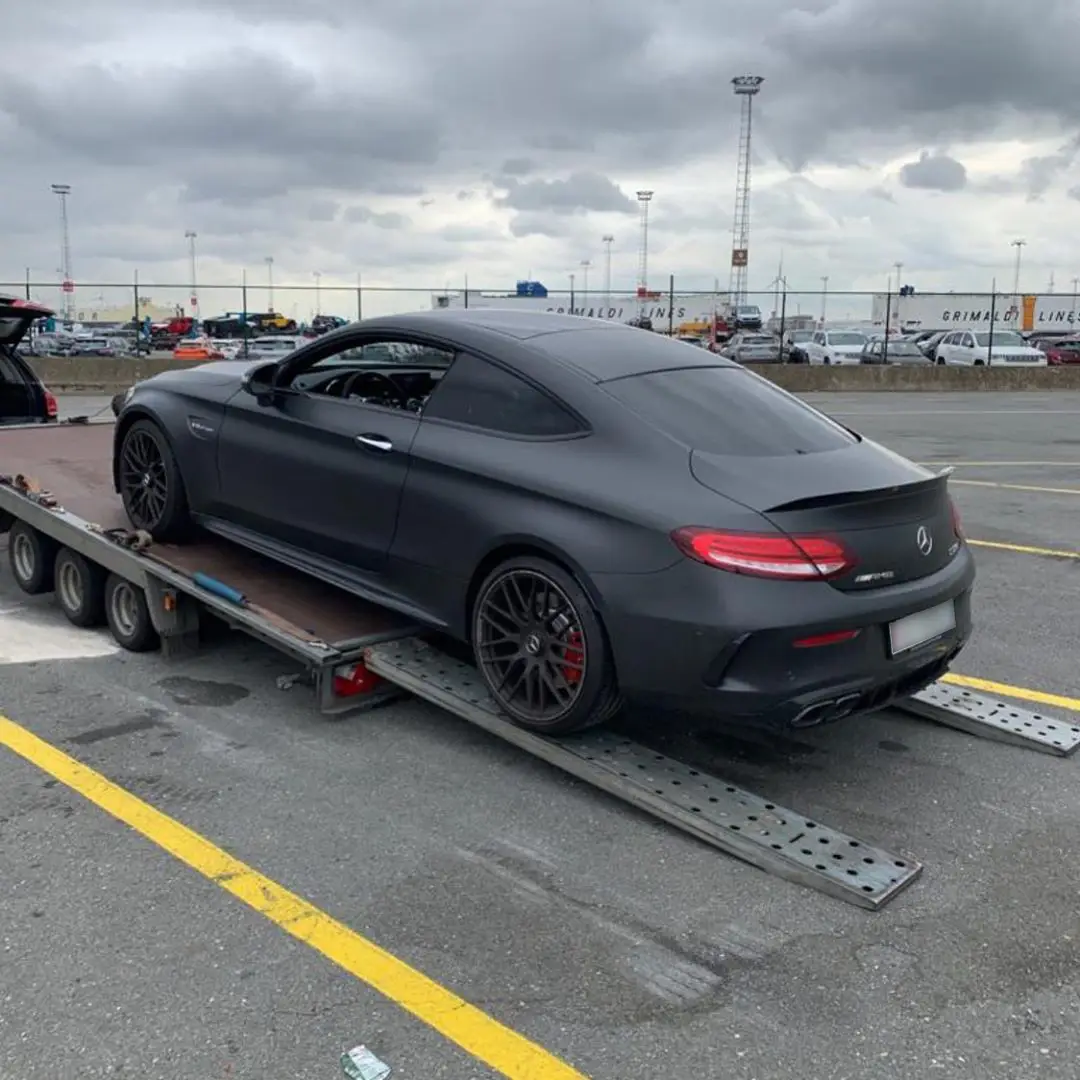
The UK formally left the EU customs union on 1 January 2021. For car shipping, that was the day a UK-registered vehicle crossing the Channel stopped being an internal movement and became a customs event. Five years of practice have produced a settled set of procedures — none of them difficult, all of them slow to do for the first time. What follows is the working brief we share with clients shipping cars between the UK and the EU in 2026.
What actually changed at the border
The headline change is procedural rather than financial. Under the EU–UK Trade and Cooperation Agreement, signed Christmas Eve 2020 and in force from 1 January 2021, the UK and the EU operate a zero-tariff, zero-quota trade in goods of qualifying origin. That means a Ford Fiesta built in Cologne, or an Aston Martin built in Gaydon, attracts no import duty when it crosses the Channel. The financial penalty of Brexit on car shipping is not tariff — it is paperwork.
Before 1 January 2021 a UK-registered car driving onto a Eurotunnel shuttle at Folkestone, or a UK-licensed transporter loaded at Dover, was making an internal community movement. No export declaration on the UK side. No import declaration on the French side. No customs entry, no carnet, no transit document. You simply drove on, drove off, paid for the ticket. After 1 January 2021, every cross-Channel car movement requires documentation. Owner-driven on a holiday, shipped enclosed to a summer residence, or carried on a transporter to Monaco for the Grand Prix — all of it now needs declaring.
Temporary admission — the six-in-twelve rule
The single most useful concept for any UK owner taking a car to the EU is temporary admission. It is the regime that allows a UK-registered car to enter the EU customs territory, stay for a defined period and leave again without paying import VAT or duty. For private vehicles owned by a person established outside the EU, the limit is six months in any rolling twelve-month period. The clock starts the moment the vehicle enters the EU and runs against the combination of vehicle and owner — not against the driver, not against the journey, not against the calendar year.
The framework sits in Article 250 of the Union Customs Code and the supporting Delegated and Implementing Regulations. In practice, customs at Calais, Marseille, Algeciras or Genoa do not ask you to fill anything in at the border for private temporary admission of a passenger car — the regime is implicit on the vehicle's UK registration and the owner's declaration on request. The discipline is on the owner to track the days. Stay 181 days in a rolling twelve-month period and the car is, in customs terms, permanently imported. VAT becomes due at the destination country's rate (20% France, 21% Spain, 22% Italy), plus the cost of regularising the position with a registration change.
The clock runs against the vehicle and the owner. Lend the car to a friend for a week in Provence — it still counts.
Two clarifications matter. First, the six months is cumulative, not consecutive — three trips of two months each will exhaust it. Second, the residence test is the owner's, not the driver's. A UK-resident owner whose Bentley lives at a Monte-Carlo garage and is driven by their Monaco-resident partner is still UK-resident for temporary-admission purposes, and the six-in-twelve limit applies.
T1 transit — the document that keeps the consignment moving
Where a car is shipped by transporter rather than driven, the load is in commercial movement and needs a transit document. The standard instrument is the T1 — the EU's common transit procedure, governed by the Convention on a Common Transit Procedure of 20 May 1987 and its later amendments. T1 opens at the office of departure (in our case the UK port — Folkestone, Dover, Felixstowe or Southampton, depending on routing) and discharges at the office of destination (the EU customs office nearest the delivery address).
The practical effect is that the car travels under customs control from the moment the trailer leaves the UK until the moment it clears EU customs. No VAT is levied at the first border the trailer crosses; no separate import declaration is needed at every internal frontier. T1 is supported by a comprehensive guarantee — your shipper carries the guarantee on your behalf, and the cost is included in the customs handling line of the quote. T1 is unfamiliar to most owners because it did not exist for UK-EU traffic before Brexit. It is now routine on every commercial cross-Channel car movement.
ATA carnets — when they apply and when they do not
The ATA carnet — Admission Temporaire / Temporary Admission — is an international customs document for the temporary movement of goods, including vehicles, between participating countries. It is issued in the UK by the London Chamber of Commerce and Industry, costs from around £325 plus a security deposit calculated on the value of the goods, and is valid for one year. A carnet allows the vehicle to clear customs at any participating country's border simply by presenting the document.
Three scenarios where a carnet matters. First, where the vehicle is being shown at a concours or motor show in the EU — Goodwood Revival entries travelling to Villa d'Este, for example. Second, where the vehicle is going to a track day, hillclimb or rally stage in commercial use. Third, where the journey crosses non-EU customs territories on its way, for example a UK car taken on to Switzerland (not in the EU customs union) or onward to the Western Balkans. Carnets are not normally needed for the UK-resident owner driving privately to a holiday home in France, Spain or Italy — temporary admission covers that scenario.
The Schengen border experience in 2026
UK passport holders are non-Schengen nationals and have been since 1 January 2021. The visible change for car shipping is the stamp in the passport — the 90-in-180 rule applies to the person, the six-in-twelve to the vehicle, and the two clocks run independently. The EU Entry/Exit System has now phased in across the Schengen external border, including the juxtaposed UK terminals at Folkestone and Dover. The driver scans on entry and on exit; biometric data is held; the system tracks the person-days automatically and flags overstay against the 90-in-180.
ETIAS — the European Travel Information and Authorisation System — is now active in 2026 for UK passport holders. It is a pre-travel authorisation, valid for three years, costing seven euros. It is not a visa. It does not replace temporary admission or any of the goods-side paperwork. It does mean that the driver, whether owner or chauffeur, needs to hold a valid ETIAS before boarding the shuttle.

The cost of getting the paperwork wrong
Three failure modes account for most of the trouble we see. First, owners who exhaust the temporary admission clock without noticing — a winter ski trip, an Easter break, a summer at the villa, a return at Christmas. Six months arrive faster than people expect, and once the threshold is crossed the EU customs authorities can require full import VAT against the open-market value of the car. For a £200,000 supercar in France, that is a £40,000 invoice plus penalty.
Second, a T1 opened in the UK but not discharged at the EU office of destination — for instance because the trailer delivers door-to-door and the driver does not present the paperwork at the local customs office. The T1 guarantee remains live, the consignment looks lost to customs, and the guarantor (your shipper) is exposed to a claim. The resolution is administrative but it eats weeks. A competent shipper discharges T1 correctly on every move; the symptom of incompetence is silence on the question.
Third, attempts at carnet-based movement where temporary admission would have been cleaner, or vice versa. The wrong regime is not catastrophic, but it adds cost and time. The right answer depends on owner residence, intended duration, commercial versus private use, and the specific countries on the route. It is a conversation worth having at quote stage rather than at the port.
What this means for a typical shipment
A representative move: a UK-resident owner shipping a Ferrari Roma from a Cotswolds residence to a summer villa in Saint- Tropez, enclosed transport, July collection, October return. The shipper opens the export declaration on the UK side, opens T1 at Folkestone, discharges T1 at the customs office serving Saint-Tropez, and the vehicle enters under temporary admission for the duration of the stay. Three months consumed against the six-month allowance. No VAT, no duty. The shipper carries the T1 guarantee. Customs handling is a separate line on top of the freight. The owner sees a clean delivery and a clean return.
The same move pre-Brexit would have skipped the export declaration, the T1, the temporary-admission consideration and the customs handling line entirely. The car would have travelled as freely as a car between Manchester and Edinburgh. That world is gone. The new world is more deliberate, more documented, but settled. Owners who treat the paperwork as a known cost and a known process — rather than a surprise on departure morning — ship between the UK and the Continent without incident.
Northern Ireland and the practical exception
Northern Ireland sits in a different position to Great Britain under the Windsor Framework — the successor to the original Northern Ireland Protocol agreed in February 2023. In practical terms, for car shipping, a vehicle moving between Northern Ireland and the Republic of Ireland (or any other EU member state via the Republic) does not need a T1 transit document or an export declaration. The same vehicle moving from Great Britain to Northern Ireland uses the green-lane arrangements for trusted-trader movements. Most ICM traffic originates in Great Britain, but for owners with collection points in Belfast, the routing reality is materially different. Brief at quote stage if the collection address is in Northern Ireland.
Switzerland and the non-EU detour
Switzerland is not in the EU customs union. A car shipped from the UK to Geneva, Zurich or Saint-Moritz crosses two customs territories — the EU on the way in via Calais, and Switzerland on the way out of the EU at one of the alpine border crossings. The T1 transit document covers the EU leg; a separate Swiss temporary import declaration is opened at the Swiss border, backed by a security deposit calculated on the value of the vehicle. Swiss federal customs (Bundesamt für Zoll und Grenzsicherheit) processes the declaration at the border. The deposit is refundable on exit. For owners with a Saint-Moritz or Gstaad chalet, this is a routine addition to the paperwork stack and not a barrier to a clean delivery.
Monaco — in customs union with France
Monaco sits inside the French customs territory by treaty and operates with French customs procedures at its borders, even though it is constitutionally an independent Principality. That means a UK car arriving in Monte-Carlo via Calais and the A8 autoroute clears customs once, at the French point of entry, and is in free circulation across the French and Monégasque territory thereafter. There is no separate Monégasque customs entry. For the working detail of a UK-to-Monaco shipment, see our piece on the Ferrari-to-Monaco cost guide.
For the route detail, see our pages on European customs clearance, the UK-to-France route, and our specialist work into Monaco and Saint-Tropez.